Near-infrared Metallicities, Radial Velocities and Spectral Types for 447 Nearby M Dwarfs
Newton, Charbonneau, Irwin et al. (2014)
Published in The Astronomical Journal, 147, 20
ADS |
ArXiv
With my collaborators, I obtained moderate resolution near-infrared (NIR) spectra of 447 mid to late M dwarfs in the solar neighborhood. These stars are targets of the MEarth Survey, a transiting planet survey looking for super Earths around nearby M dwarfs. We derive an empirical calibration for [Fe/H] and a photometric metallicity calibration relating NIR colors to Na equivalent width (however, see Newton et al. (2015) for an update). We also develop a spectroscopic distance calibration that is based on NIR spectral type or an index measuring curvature in the K-band, and a relation between optical and NIR spectral type measures. The data tables are available on this website and in the refereed journal article.
Data Tables Figures Spectral Standards
Data
Our telluric corrected spectra are available online in our Harvard Dataverse repository.
Tables
Our measured and inferred properties are presented in two tables. Data include positions, proper motions, 2MASS Ks magnitudes, by eye NIR spectral types, select measured spectral features, inferred [Fe/H], measured radial velocities, spectroscopic distance estimates, and spectral types, radial velocities and parallaxes from the literature where available. In IDL, machine readable tables can be read with the read_fmr.pro routine. Machine readable tables are available here and in the online format of this article. PDF versions of the LaTeXed table are only available here.
Table A1: Measured and inferred properties of 447 M dwarfs in our nearby, rotation, and potential calibrator samples.
Machine readable |
PDF LaTeX
Table A2: Measured and inferred properties of M dwarfs presented in Rojas-Ayala et al. (2012), updated to facilitate joint use of our data.
Machine readable |
PDF LaTeX
Figures
Figures 4-7 (as jpg), which present composite NIR spectral type standards based on the KHM system. We assessed the spectral type of all stars observed through the 2012A semester using the IRTF spectral library stars as standards, then median-combined stars of a single spectral type with near-solar metallicities.
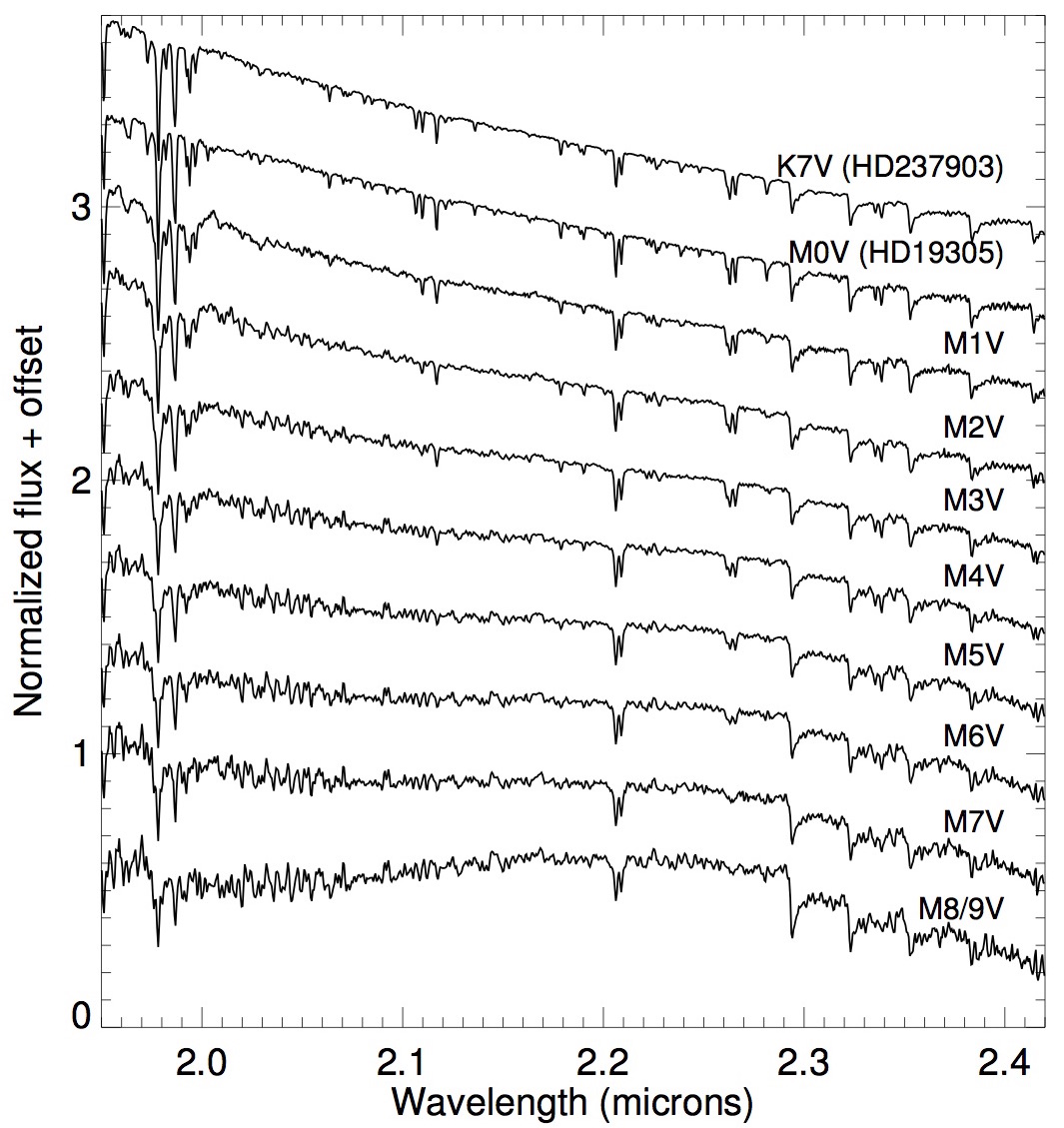
Z-band | J-band | H-band | K-band


There were two stars comprising the M1V spectral standard with median [Fe/H]=0.05, 10 in M2V with [Fe/H]=0.0, 17 in M3V with [Fe/H]=0.02, 45 in M4V with [Fe/H]=0.01, 48 in M5V with [Fe/H]=0.03, 18 in M6V with [Fe/H]=0.04 and six in M7V with [Fe/H]=0.04. We included all five M8/9V stars observed through the 2012A semester and continued to use the IRTF spectral library standards for K dwarfs and M0V stars.
Composite Spectral Standards
We used median-combined stellar spectra, as our spectral standards. A zip file containing these (including additional low/high metallicity combinations) is available for download.